THE REGGIO EMILIA APPROACH TO EDUCATION: What Is It and Why Is It Beneficial?

Every day, little curious children walk through the doors of our preschool, ready to explore the world. Each of them brings their own unique perspective on the world, hundreds of questions, and hundreds of ways to answer them.
Our most important task is to listen to their questions, recognize their ideas, and give them room to grow. We believe that every child is unique and that their voice matters.
We are creating a world where every small step becomes a great discovery, and every child’s thought inspires the creation of something new.
In our daily lives, we draw on the Reggio Emilia philosophy, which allows children to grow up to be free, confident, and happy.
“Reggio Emilia-inspired education—the hundred languages of the child. Our educational philosophy is inspired by the Reggio Emilia approach, whose principal founder, Loris Malaguzzi, believed that every child is creative, curious, and capable of creating their own unique experience of the world.”

As Malaguzzi said:
“A child has a hundred languages, a hundred hands, a hundred thoughts, a hundred ways of thinking, playing, speaking, marveling, and loving; a hundred joys to sing and understand; a hundred worlds to discover; a hundred worlds to invent… A child has a hundred languages.”
These “hundred languages” are not just words, but also dance, music, art, drawing, writing, creating, speaking, and even movement or silence. Through them, children not only discover the world, but also express themselves—their thoughts, feelings, and understanding.
We believe that every child is unique—they learn in their own way, think critically, assess situations, express their opinions, and explore through experience and play. Children learn by recognizing, experimenting, observing, listening, and making connections between different phenomena. We place great emphasis on the learning environment—for us, it is not merely a backdrop, but an active part of the learning process, what is often referred to as the “third teacher.” We strive to ensure that it inspires children to explore, experiment, ask questions, seek answers, and discover the world through their own eyes.”
-Kristina, Head of the SODO Branch
REGGIO EMILIA APPROACH: Why is it useful?

Encourages creativity. From an early age, children learn to express their ideas confidently and seek unconventional solutions.
Strengthens communication skills. Group activities teach children to collaborate, listen to others, and share their thoughts.
Builds self-confidence. Every small project or exploration is a success that builds a child’s courage and belief in their own abilities.
Fosters critical thinking. Questions like “why?” and “how?” are encouraged—this helps children become curious explorers.
Promotes independence. Children choose their own activities and decide how and what they want to explore.
Encourages parental involvement. Parents become co-creators of the educational process—this strengthens the bond between the family and the preschool.
“Our preschool follows the Reggio Emilia approach, which we are very happy about and proud of. This approach encourages children’s independence, individuality, creativity, and collaboration with others and their environment.”

We start every morning with a morning circle—an important part of the day’s beginning, during which we learn poems and songs with the children, talk about emotions, and discuss our plans for the day.
Our activities often involve the senses and exploration. Children create using unconventional materials: pasta, small stones, and toilet paper rolls.
In this way, we nurture their imagination and creativity, and every activity becomes a discovery.
Children especially love outdoor learning, and we are happy to incorporate it into our activities. Twigs, pebbles, tree leaves, and the little bugs we find in the meadows become tools for learning and playing. Together with the children, we count pebbles, build homes for snails, and create patterns using natural materials.
One of our favorite games is “Nature Bingo,” in which we look for natural objects depicted in pictures. This activity encourages communication, teamwork, and the joy of discovery. Let’s encourage children to learn, explore, and create together—after all, the world around us is full of wonderful opportunities to learn!
-Goda, teacher in the Toddler Group at the PIEVOS branch
What does this mean in everyday life?
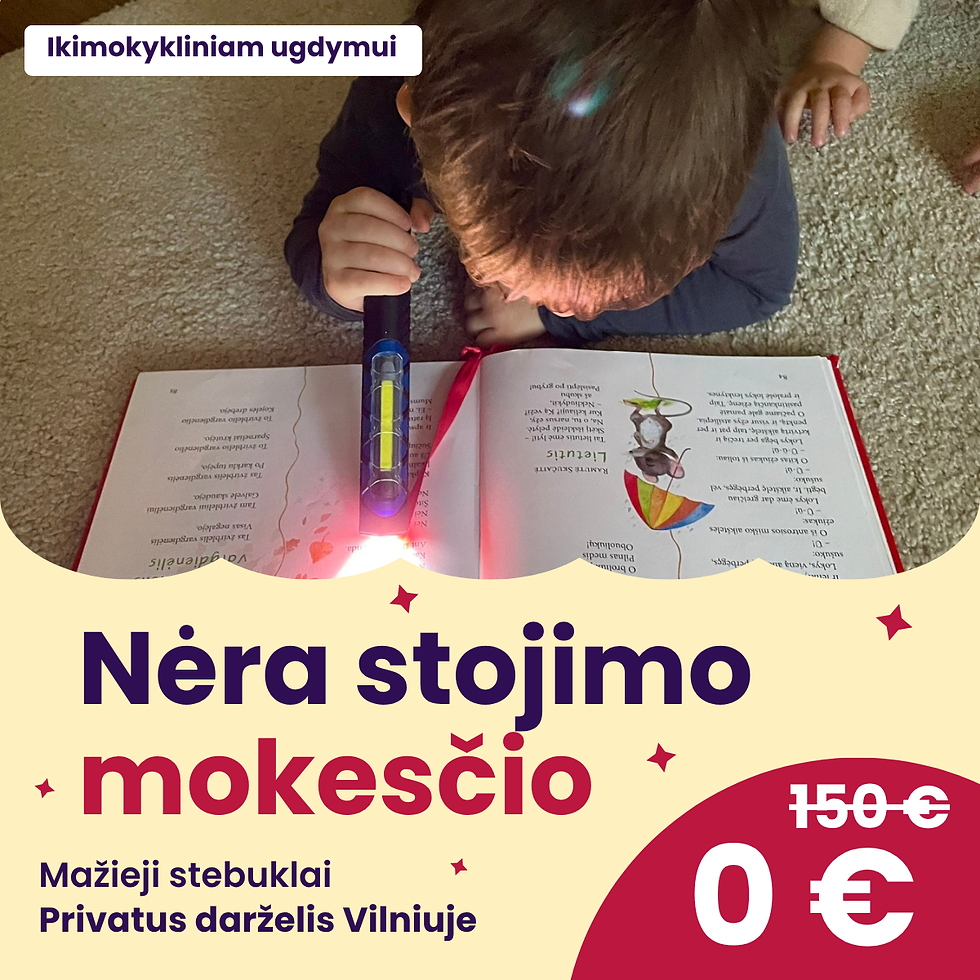
Children explore the interplay of light, shadows, and colors—they observe how light changes shape, color, or mood.
They create using a wide variety of natural and recycled materials—boxes, twigs, fabrics, and pebbles.
They construct stories, draw their feelings, and craft fairy tales—learning to express their thoughts in “a hundred languages.”
They observe nature, listen to sounds, and seek answers to questions like “What if…?”
They learn from one another—together they build, discuss, debate, and find solutions.



Comments